Your home shouldn’t disappear when the sun goes down. Low voltage landscape lighting is one of the most impactful upgrades you can make to your home’s exterior, and most homeowners don’t realize just how dramatic the difference is until they see it for themselves.
Think about it. You’ve put real time and money into your lawn, your garden beds, and your front porch. But the moment it gets dark, all of that vanishes. Your home blends into the shadows. Guests struggle to find the path to your front door. That curb appeal you’ve worked so hard to build? Gone.
Good residential landscape lighting changes everything. It highlights your home’s best features, makes walkways safer at night, and creates the kind of warm, welcoming ambience that makes your property stand out on the block. It’s not just decorative, it’s functional, energy-efficient, and genuinely worth every dollar.
In this guide, we’ll walk through everything you need to know about outdoor lighting for your home. What it is, how it works, what it costs, and why hiring a professional makes a real difference, especially here in Charlotte, NC.

Low voltage landscape lighting runs on 12 volts instead of the standard 120-volt household current. A transformer plugs into a regular outdoor outlet and steps the power down before it ever reaches your lights. The result is a system that’s safe, efficient, and easy to maintain.
Because the voltage is so low, the wiring won’t shock you if you touch it. That makes it far safer than traditional high-voltage systems, for your family, your kids, your pets, and anyone doing installation or upkeep down the road.
Most modern systems pair low voltage wiring with LED fixtures, which use a fraction of the energy that older halogen bulbs did. You get beautiful garden lighting without a painful electricity bill. LEDs also last dramatically longer, we’re talking years, not months. It’s a smarter system all around.
The system has three main parts: a transformer, the wiring, and the fixtures. That’s really it.
The transformer is the brain of the whole setup. It plugs into your outdoor outlet and brings 120-volt power down to a safe 12 volts. Most modern transformers have built-in timers, and some connect to smart home systems so your lights come on automatically at dusk and shut off at a set time. No flipping switches, no forgetting to turn things off.
From the transformer, low-voltage cable runs through your yard. It’s buried just a couple of inches below the surface, or tucked under mulch, and connects to each fixture along the way. Multiple lights can run off a single cable, which keeps the installation clean and the wiring hidden.
The fixtures are the actual lights. Path lights, spotlights, uplights, and floodlights each connect to the cable and get aimed exactly where you want them. Point a spotlight up into a mature tree, and you’ve got stunning uplighting. Line a walkway with path lights, and your front yard suddenly looks like a high-end resort after dark.
When the system is designed and installed correctly, the wiring disappears completely. The fixtures blend into the landscape during the day. And at night, your whole property transforms.
Here’s why so many homeowners in Charlotte, NC, are making this upgrade. The benefits go well beyond “it looks nice.”
Safety and security. Well-lit pathways prevent trips and falls, especially important if you have kids, elderly family members, or frequent guests. Outdoor security lighting also deters intruders. A dark yard is an open invitation. A well-lit one sends a very different message.
Curb appeal that actually lasts through the night. Nightscape lighting makes your home look polished and intentional from the street. It’s one of the fastest ways to improve curb appeal without touching a single plant or replacing a single shrub.
Energy efficiency. LED low voltage lighting sips electricity. Your lights can run every single night and barely register on your utility bill compared to older halogen or high-voltage systems. The savings add up fast over time.
More usable outdoor space. A lit patio, deck, or backyard extends your living area well into the evening. That’s more time outside with your family, more nights enjoying your space instead of retreating indoors the moment the sun sets.
Property value. Professional exterior home lighting is a recognized upgrade. Buyers notice it. It signals that a home has been cared for and that the outdoor spaces are worth spending time in.
Low maintenance. LED bulbs last for years. Once your system is installed correctly, you mostly just enjoy it. No constant replacements, no complicated upkeep.
If you’re already working toward a low maintenance landscape design, adding lighting is the natural next step. It lets you enjoy that beautiful, easy-care yard even after dark, without adding a single extra chore to your week.
Every yard is different, but some spots almost always deliver big results. Here’s where a good lighting designer will typically focus:
Pathway lighting. Path lights along your walkway guide guests safely to your front door. They’re usually the first thing visitors notice and the first thing designers recommend. Simple, impactful, and always worth it.
Driveway lighting. Driveway lights mark the edges of your entry, improve nighttime visibility, and make your whole property look more polished from the street. It’s a small detail that makes a big first impression.
Patio and deck lighting. Patio lighting installation turns your outdoor living area into a place you’ll actually use after dark. Whether it’s recessed step lights, subtle in-ground fixtures, or soft overhead options, the right setup makes your deck feel like a true extension of your home.
Tree uplighting. Aiming a light up into a mature tree creates drama and depth that nothing else quite matches. It’s one of the most striking effects in landscape lighting design, and one of the most underused.
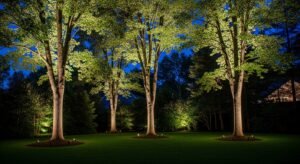
Garden accent lighting. Highlight your best garden beds, flower borders, or architectural shrubs. Without lighting, those features simply disappear at night. With it, they become focal points that carry your landscaping into the evening hours.
Architectural lighting. Washing your home’s facade with soft light adds dimension and presence. It makes the whole structure look intentional, like someone actually thought about how the home looks after dark, because they did.
For backyard lighting design ideas that cover the whole property, it really helps to work with professionals who can look at your space as a whole and figure out where light will do the most good, not just where it’s easiest to run cable.
Let’s be upfront: the cost of landscape lighting installation varies. And that’s not a dodge, it’s just the truth. Your yard size, the number of fixtures, the type of lights you choose, and whether you want smart automation all affect the final number.
That said, here’s a general picture for most residential projects in Charlotte, NC:
A basic starter system with pathway lights and a few accent fixtures might run anywhere from $500 to $1,500 installed. A mid-range system with pathway lighting, uplighting, patio fixtures, and driveway lights typically lands between $1,500 and $4,000. Larger, more customized installs with smart controls, architectural lighting, and full property coverage can run $5,000 or more.
Those numbers might sound significant. But here’s the thing: this is a one-time investment that delivers value every single night for years. The low voltage lighting installation pays for itself in curb appeal, safety, and energy savings over time. And with LED fixtures that last a decade or more, you’re not constantly spending money on replacements.
Affordable outdoor lighting in Charlotte, NC, doesn’t mean cutting corners. It means getting the right system designed for your actual property, not overselling you on fixtures you don’t need, and not underselling you on quality that won’t hold up.
The best way to know your actual cost? Request a free estimate. A professional will look at your property, talk through your goals, and give you a real number, not a wild guess.
Yes, you can buy a landscape lighting kit at the hardware store and install it yourself over a weekend. And if your goal is a handful of path lights along a short walkway, that might be perfectly fine.
But here’s where DIY starts to get complicated.
Designing a system that actually looks good takes experience. It’s not just about placing lights, it’s about understanding how light behaves at night, how different fixture types interact, where shadows fall, and how to avoid common mistakes like over-lighting or washing out your home’s best features. These things are hard to get right without a trained eye.
Wiring is another issue. Running cable incorrectly, overloading a transformer, or placing fixtures without accounting for future maintenance can create real problems down the road. Connections that aren’t done properly can corrode, short out, or fail, and then you’re digging up your yard to figure out why half your lights stopped working.
Professional outdoor lighting services handle all of that for you. A qualified landscape lighting contractor brings design expertise, quality materials, and installation experience that a weekend project simply can’t match. The fixtures are placed correctly. The wiring is done right. The system is built to last.
And if something does need attention later, a light gets damaged, a bulb needs swapping, a zone needs adjusting, a professional service is just a phone call away. That peace of mind has real value.
If you’re serious about the result, hire a landscape lighting contractor. The difference in quality, durability, and long-term performance is hard to overstate.
For a full picture of what professional installation looks like alongside other outdoor services, you can also explore Landscaping Services in Charlotte, NC, to see how lighting fits into a complete property upgrade.
Not sure how low voltage stacks up against other systems? Here’s a simple comparison:
Feature | Low Voltage (12V) | High Voltage (120V) | Solar |
Safety | Very safe | Higher risk | Safe |
Energy efficiency | Excellent (LED) | High consumption | Free energy |
Reliability | Consistent | Consistent | Weather-dependent |
Light output | Strong & adjustable | Very bright | Often dim |
Installation | Flexible, DIY-friendly | Requires electrician | No wiring needed |
Lifespan | Long (LED) | Moderate | Battery degrades |
Professional design options | Excellent | Good | Limited |
Solar sounds appealing, but it comes with real limitations. The light output is often weak, the batteries degrade over time, and performance drops significantly in cloudy or shaded conditions, which describes a lot of yards in Charlotte, NC, during fall and winter. Wired low voltage systems simply deliver more consistent, reliable illumination night after night.
High voltage systems require a licensed electrician for every fixture and carry a higher safety risk. They’re rarely the right choice for residential landscape lighting.
Low voltage wins on nearly every front for homeowners who want great results without headaches.
Landscape lighting has come a long way from basic path lights and motion sensors. Today’s outdoor illumination is thoughtful, design-forward, and increasingly integrated with smart home technology.
Layered lighting is one of the biggest trends right now. Rather than just placing a few lights and calling it done, designers create depth by combining multiple fixture types, uplights for trees, path lights for walkways, and wall-wash fixtures for architecture, so the whole yard feels cohesive and dimensional at night.
Smart controls are becoming standard on high-end installs. Zoned systems let you control different areas of your yard independently, adjust brightness levels, and set custom schedules from your phone. Some systems even respond to sunrise and sunset automatically, no programming required.
Warm white LED color temperatures have replaced the harsh, bluish light that plagued early LED fixtures. Today’s LEDs produce a rich, golden-toned light that feels natural and luxurious, not like a parking lot.
Architectural outdoor lighting is growing in popularity among modern homes. Instead of just lighting the landscaping, designers are also highlighting the lines of the home itself, the roofline, columns, gables, and facades, to create a stunning nighttime silhouette.
Minimalist fixture design is another shift. Modern landscape lighting fixtures are increasingly sleek and low-profile, designed to disappear during the day so the plants and architecture stay front and centre.
These trends are shaping what outdoor ambience lighting looks like in upscale neighbourhoods across Charlotte, NC, and the results are genuinely stunning.

One of the best things about a well-installed low voltage LED system is how little attention it needs once it’s up and running.
LED fixtures are built to last. Quality landscape lighting bulbs typically have lifespans of 25,000 to 50,000 hours. Run your lights five hours a night, and you’re looking at over a decade before you’d need to think about replacements. That’s a completely different proposition than the old halogen systems that burned out every season.
The wiring and fixtures in a properly installed system are weatherproof and designed for outdoor exposure. That means rain, heat, and cold don’t compromise the system. Good-quality waterproof landscape lighting holds up under real conditions, not just ideal ones.
That said, it’s worth having your system checked every year or two. Connections can loosen after ground shifts, fixtures can get nudged by landscaping work, and transformers benefit from an occasional settings check. A quick annual walkthrough from a professional keeps everything running at its best.
The bottom line: install it right once, and you’re mostly just enjoying it from that point forward.
There’s a real advantage to working with a company that knows Charlotte, NC specifically. The climate here, the summer humidity, the occasional ice storms, and the clay-heavy soil, affect how systems are installed and what materials hold up best over time. Local experts know all of that already.
A local landscape lighting company in Charlotte, NC, also understands the neighbourhood aesthetic. What looks stunning in a historic Fourth Ward craftsman is different from what works in a modern Ballantyne home. Design choices that fit the architecture and landscaping of your specific property require someone who’s actually spent time working in this area.
Beyond expertise, local professionals are accountable. They’re not a faceless online retailer shipping you a kit. They’re a team that stands behind their work, returns your calls, and shows up when something needs attention.
The Landscaping Lights in Charlotte, NC service page goes into more detail about what a professional installation process looks like from start to finish, worth reading if you want to know exactly what to expect.
When you work with experienced outdoor lighting installers in Charlotte, NC, you’re not just getting lights in the ground. You’re getting a fully designed system, professionally installed, backed by people who will be there if you ever need them.
If your home goes dark at night, it’s time to change that.
Low voltage landscape lighting is one of the smartest, most rewarding investments you can make in your property. It improves safety, boosts curb appeal, extends your outdoor living space, and makes your home look genuinely beautiful after sunset, every single night.
Whether you’re ready to move forward or just starting to explore your options, the best next step is a conversation with a professional. Request a free estimate and get a real, no-obligation quote tailored to your property. A local landscape lighting expert will walk your yard, talk through your goals, and show you exactly what’s possible.
Schedule your outdoor lighting consultation today. Your home deserves to look just as good at 9 PM as it does at noon.