You should mow your lawn every 5 to 10 days during the growing season, not on a fixed weekly schedule. The real answer depends on how fast your grass is growing, not what day of the week it is.
A lot of homeowners set a mental rule, like “I mow every Saturday,” and stick to it no matter what. But grass doesn’t care about your calendar. It cares about sunlight, water, temperature, and the season. Some weeks your lawn might need a trim every five days. Other weeks, especially in summer heat or winter cold, it might not need cutting for two weeks or more.
Getting your lawn mowing frequency right matters more than most people realize. Cut it too often, and you stress the grass. Wait too long, and you invite weeds, pests, and a scalped-looking yard once you finally do mow. The sweet spot keeps your lawn health strong and your yard looking sharp without wearing down the roots.
In this guide, you’ll learn how to build the best mowing schedule for your lawn, broken down by season, grass type, and climate.
Here’s the general rule: most lawns need mowing every 5 to 10 days when the grass is actively growing. That’s the honest answer to “how often should I mow my lawn,” but it’s really just a starting point.
The better rule to live by is this: never mow based only on the calendar. Instead, follow the One-Third Rule. Mow whenever your grass has grown tall enough that cutting it will remove about a third of the blade height. Once you start watching your grass instead of your calendar, the right grass cutting schedule becomes obvious.
During spring and early summer, when grass grows fastest, you might mow twice a week. In late summer heat or a dry spell, you could stretch that to every 10 to 14 days. In cooler months, mowing frequency drops even more.
So instead of asking “what day do I mow,” ask “how tall is my grass right now?” That shift is the key to a correct mowing schedule and a healthier lawn.
Several things work together to decide how often your grass needs a trim. Let’s break each one down.
Your grass growth rate is driven by a handful of factors: sunlight, rainfall, watering habits, fertilization, and temperature.
Grass growing in full sun with regular rainfall will shoot up fast. Grass in shady, dry patches grows much slower. If you’ve recently fertilized, expect a growth spurt that calls for more frequent mowing. Heavy rain or extra irrigation has the same effect, since moisture fuels growth just as much as sunlight does.
Temperature matters too. Warm weather, without extreme heat, pushes grass into its most active growth phase. That’s where lawn mowing frequency by climate comes into play. A lawn in a humid, rainy region will need more frequent cuts than one in a dry climate, even with the same grass type.
Not all grass grows at the same speed. The type of turf in your yard has a big impact on how often it needs cutting.
Grass Type | Growing Season | Recommended Frequency |
Bermuda | Warm season (spring–fall) | Every 5–7 days |
Kentucky Bluegrass | Cool season (spring, fall) | Every 5–7 days |
Tall Fescue | Cool season (spring, fall) | Every 7–10 days |
Zoysia | Warm season (late spring–summer) | Every 7–14 days |
St. Augustine | Warm season (spring–fall) | Every 7–10 days |
Centipede | Warm season (spring–summer) | Every 10–14 days |
Ryegrass | Cool season (fall–spring) | Every 5–7 days |
Mowing frequency for Bermuda grass tends to run high since it’s a fast, aggressive grower during warm months. If you’re wondering how often to mow Kentucky bluegrass, plan on weekly cuts during its cool-season growth spurts in spring and fall.
Mowing tall fescue lawn areas usually means a slightly longer gap between cuts, since fescue grows a bit slower. If you’re dealing with how often to mow St. Augustine grass, stick to a 7 to 10 day window. Mowing Zoysia grass and mowing centipede grass can both be spaced out further, since these warm-season types grow slower than Bermuda. And mowing ryegrass, often used for overseeding in winter, usually needs weekly attention during its cool-season growing window.
A new lawn plays by different rules than an established one.
If you’re wondering how often you should mow a new lawn, wait until the grass reaches about 3 to 4 inches tall for the first cut, so the roots have time to establish. For newly seeded grass, patience matters even more: don’t mow until it’s rooted deeply enough that a gentle tug won’t pull it from the soil.
Once your lawn is established, with strong roots and consistent turfgrass coverage, you can settle into a predictable schedule based on grass type and season.
Your mowing frequency should shift as the seasons change. Here’s a quick breakdown:
Season | Mowing Frequency | Why |
Spring | Every 5–7 days | Rapid growth from rainfall and mild temps |
Summer | Every 7–14 days | Growth slows in heat and drought |
Fall | Every 7–10 days | Growth picks back up as temps cool |
Winter | Rarely or not at all | Most grass goes dormant |
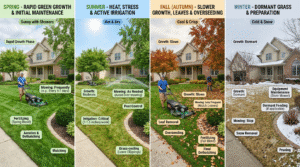
Spring is when grass grows the fastest. Rainfall picks up, temperatures warm, and nitrogen from any spring fertilizer kicks the grass into high gear. This is when how often to mow lawn in spring becomes a real question almost every week. Don’t be surprised if you’re mowing twice in one week during peak growth. The main spring lawn mowing tip: keep an eye on blade height, since it can sneak up fast.
Summer mowing frequency depends heavily on rainfall and heat. In a lot of climates, growth actually slows once peak summer heat and humidity set in, especially during a drought. How often to mow lawn in summer really comes down to whether your grass is getting enough water. Mowing during a drought should be done carefully, since stressed grass is more vulnerable to damage. If you’re mowing in hot weather, raise your mower height a notch and mow during cooler parts of the day.
As temperatures cool, cool-season grasses often get a second wind. How often to mow lawn in fall depends on your region and grass type, but expect growth to pick back up compared to peak summer. This is also a good time to think about overseeding and fall fertilizer to help your lawn recover before winter.
In most regions, winter brings dormancy. Frost and cold temperatures slow or stop grass growth completely, so how often to mow lawn in winter is often “not at all” until spring returns. In milder climates, you might still need the occasional light trim, but for most homeowners, winter is a mowing off-season.
If you remember one piece of advice from this whole guide, make it this: never remove more than one-third of the grass blade in a single mow.
This is the one-third mowing rule, and it’s the gold standard for a healthy lawn. Cutting off more than a third at once shocks the grass. It’s essentially the plant equivalent of a bad haircut that leaves it struggling to recover.
Following this rule gives you several benefits:
Ignore the rule too often, and you risk scalping the lawn, which leaves bare, brown patches and opens the door for weeds and pests to move in.
The best mowing height depends on your grass type. Here’s a simple lawn mowing height chart to work from:
Grass Type | Ideal Mowing Height |
Bermuda | 1–2 inches |
Tall Fescue | 3–4 inches |
Kentucky Bluegrass | 2.5–3.5 inches |
Zoysia | 1–2.5 inches |
St. Augustine | 2.5–4 inches |
So how tall should grass be before mowing? Using the One-Third Rule, you’d want to mow once your grass reaches about 1.5 times its ideal height. For example, if your ideal mowing height for Bermuda is 2 inches, you’d mow once it hits around 3 inches.
Keeping your mowing height for a healthy lawn consistent and never scalping it too short gives your turfgrass a better shot at fighting off weeds, drought stress, and disease.

Yes, mowing too often can hurt your lawn just as much as not mowing enough. Is it bad to mow your lawn every week? Not necessarily, but it depends on how much you’re cutting each time.
Can you mow your lawn twice a week? During peak spring growth, sure, if the grass genuinely needs it. But mowing too frequently when the grass hasn’t grown enough leads to problems like:
The goal isn’t to mow as often as possible. It’s to mow exactly as often as your grass actually needs, based on growth, not habit.
Skipping mowing for too long causes its own headaches. When is grass too long to mow? Once it’s grown well past the one-third threshold, cutting it back down in one pass will shock the lawn.
An overgrown lawn creates a welcoming environment for pests, fungus, and disease. Tall, thick grass holds onto moisture longer, which fungus loves, and creates hiding spots for insects.
Recovering from overgrown grass usually means raising your mower height for the first cut, then gradually lowering it over the next couple of mows, rather than scalping it all at once. Letting things go too long can also leave an uneven, patchy look once you finally cut it.
The best time of day to mow is late morning, once the dew has dried but before the afternoon heat sets in.
Morning: Grass is often still wet with dew, which clogs your mower and leads to an uneven cut.
Late morning: The sweet spot. The grass is dry, temperatures are still reasonable, and it has time to recover before evening.
Evening: Not ideal, since freshly cut grass left overnight in cooler, damper conditions is more prone to fungus and disease.
Avoid mowing during the hottest part of the afternoon, since cutting grass in extreme heat adds extra stress. And skip mowing after rain if you can help it. Wet grass clumps in the mower deck and can leave your lawn looking torn instead of cleanly cut. If you live somewhere with a rainy season, try to plan mowing around dry windows.
A few small habits go a long way toward keeping your grass in top shape:
These small habits add up, keeping your lawn thicker, greener, and more resistant to weeds.
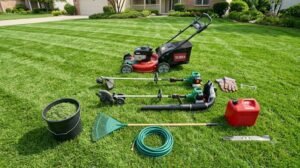
Mowing is only one piece of a full lawn maintenance routine. A truly healthy lawn also needs consistent watering, fertilization, aeration, dethatching, and occasional overseeding.
A solid lawn watering schedule helps roots grow deep and strong, making the whole plant more resilient to heat and drought. Lawn fertilization feeds your grass the nutrients it needs, mainly nitrogen, phosphorus, and potassium. Aeration loosens compacted soil so water and nutrients can reach the roots, while dethatching clears away buildup that can choke out healthy turf.
To maximize grass growth and avoid overfeeding, read our complete guide on when to fertilize your lawn.
Put together, mowing, watering, and feeding your lawn on a proper lawn care schedule gives you the best shot at a lush, green yard all season long.
If your schedule is packed, your lawn is large, or your grass seems to grow unevenly no matter what you do, it might be time to bring in help.
A lot of homeowners start out mowing on their own, then realize that keeping up with a proper lawn mowing service frequency takes more consistency than they have time for. That’s where hiring help comes in. Depending on your lawn’s needs, a weekly lawn mowing service or biweekly lawn mowing plan can keep things consistent without you having to think about it, which is especially useful for larger properties, commercial spaces, or anyone juggling a busy schedule.
Homeowners wanting consistent results often benefit from a professional Lawn Care and Maintenance Service that includes mowing, fertilization, edging, and seasonal maintenance. Rather than piecing together your own lawn care service schedule, a maintenance plan bundles everything into one predictable routine.
Mowing and fertilizing only go so far if the rest of your landscape is working against your grass. Good landscaping actually supports a healthier lawn in ways that go beyond the mower.
Proper drainage keeps water from pooling in low spots, which can drown roots and invite fungus. Thoughtful tree placement makes sure your grass gets enough sunlight instead of struggling in constant shade. A solid irrigation setup delivers water evenly across the yard instead of leaving dry patches next to soggy ones. Even clean edging along garden beds and walkways keeps grass from spreading where it shouldn’t and gives your yard a sharper, more polished feel.
If you’re planning a full yard makeover along with lawn improvements, professional Landscaping Services in Charlotte, NC can help improve drainage, curb appeal, and long-term lawn health.
At the end of the day, the best approach to mowing isn’t about sticking to a fixed weekly schedule. It’s about paying attention to how fast your grass is actually growing and adjusting from there. Follow the One-Third Rule, keep your mowing height in the right range for your grass type, and shift your routine as the seasons change.
Pair your mowing habits with regular watering, fertilization, and aeration, and you’ll set your lawn up for real, long-term health. If that sounds like more than you want to manage on your own, there’s no shame in handing it off. A professional lawn care team can keep your yard looking great year-round without you having to track every growth spurt yourself.