
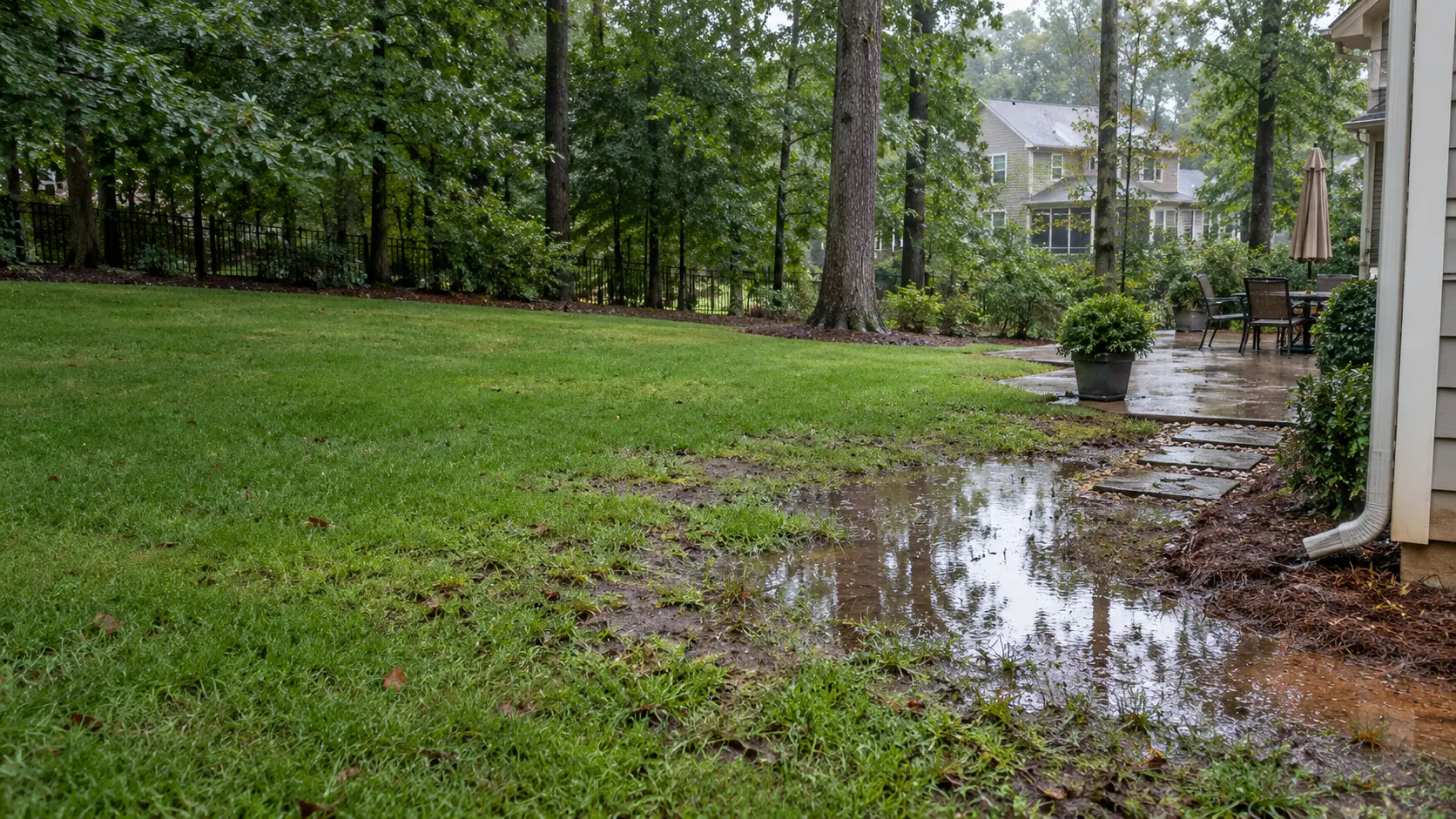
Yard Drainage & Grading in Charlotte, NC
Understand the Water Before Choosing the Drain
Standing water, soggy turf, erosion and uneven grades can interfere with lawns, planting beds, patios and other landscape improvements.
The right approach depends on where the water comes from, where it collects, how the property slopes and where the water can appropriately go. Yard drainage may involve grading, surface drainage, French drains, catch basins, downspout routing, swales or a combination of methods.
Landscapers in Charlotte NC is an independent landscaping information and service-request website. Drainage, grading and related work is performed by independent providers where available.
What Should You Do About Standing Water in a Yard?
Start by identifying the source and path of the water. Look at the property during or shortly after rain. Note low areas, downspouts, slopes, patios, driveways, retaining walls, neighboring runoff and places where water stops moving.
A French drain can help in some situations, but it is not the automatic answer to every drainage problem. Depending on the site, the starting point may instead involve grading, a swale, catch basin, downspout routing or another drainage approach.
What May Be Causing Your Yard Drainage Problem?
Water problems can have more than one cause, and several conditions may contribute to the same wet area.
Low Areas
A depression can collect surface water instead of allowing it to keep moving across the property.
Poor Surface Grade
Some areas may be too flat, slope toward the wrong location or no longer move runoff effectively.
Compacted or Clay-Rich Soil
Clay-rich or compacted soil can slow water movement and contribute to persistently wet ground.
Downspout Discharge
Roof runoff concentrated in one location can contribute to repeated pooling or saturated soil.
Hard Surfaces
Driveways, patios and walkways can change how runoff moves through the yard.
Slope Runoff
Water moving down a slope can create erosion, saturated low areas or repeated turf damage.
Charlotte soil context: NC State Extension explains that Piedmont subsoils commonly contain relatively high clay content and that construction compaction can further slow water movement. Read the NC State guidance →
Surface Water vs Subsurface Water
Understanding where the water is moving can help narrow the possible approach.
Surface Water
Surface water is visible runoff or pooling that moves across the ground.
- Water flowing across the lawn
- Runoff from a patio or driveway
- Pooling in visible depressions
- Water moving down a slope
- Water collecting at the bottom of a grade
Possible starting points may include grading, swales, catch basins or other surface-water routing.
Subsurface Water
Subsurface water moves through or remains within saturated soil.
- Consistently wet soil
- Soggy areas without obvious surface flow
- Water appearing along a slope
- A strip of turf that stays wet longer than surrounding areas
A subsurface drainage system such as a French drain may be worth assessing in some situations.
Which Drainage Solution May Fit the Problem?
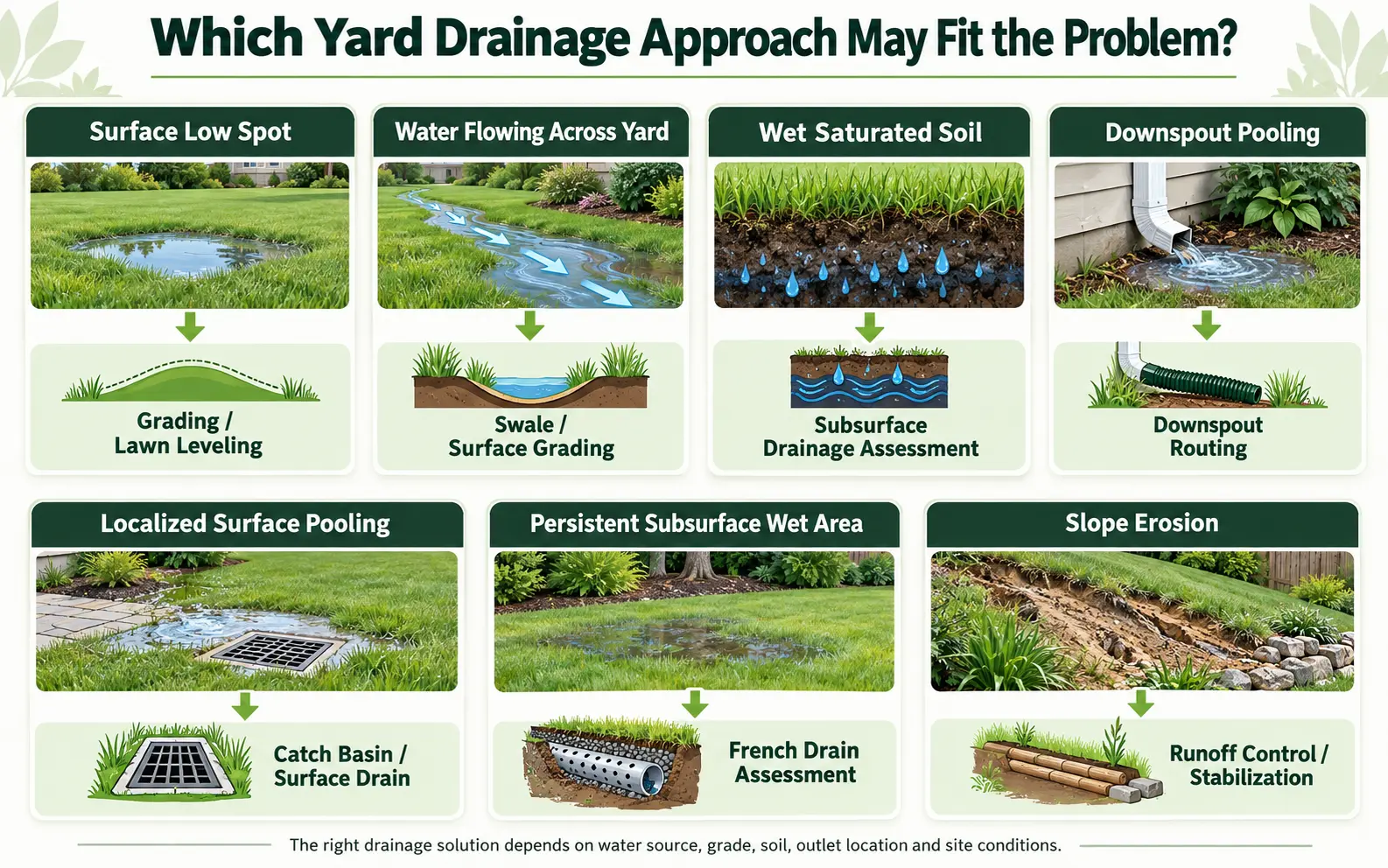
The appropriate approach depends on the actual property. This is a decision guide, not a final drainage design.
| Yard Problem | Possible Starting Point |
|---|---|
| Water collecting in a low lawn area | Surface grading or drainage assessment |
| Water flowing across the yard | Swale, grading or runoff-routing assessment |
| Persistently saturated soil | Subsurface drainage assessment |
| Pooling below a downspout | Downspout extension or drainage routing |
| Water collecting at one surface location | Catch basin or surface-drain assessment |
| Persistent wet strip or subsurface water | French drain assessment |
| Soil washing down a slope | Grading, runoff control or stabilization |
| Small shallow lawn depressions | Localized lawn leveling |
| Large uneven slope | Broader grading assessment |
| Water near a patio or retaining wall | Drainage + hardscape coordination |
| Turf repeatedly failing in wet areas | Address drainage first, then consider lawn restoration |
Signs Your Yard May Have a Drainage Problem
Some water after a heavy storm does not automatically mean a drainage system is required. Repeated patterns are more useful.
Repeated Standing Water
Water regularly remains in the same part of the yard after surrounding areas begin drying.
Soggy or Muddy Turf
Turf stays soft, muddy or difficult to use long after rain has stopped.
Erosion Channels
Soil or mulch repeatedly moves downhill and small channels begin to form.
Hardscape Pooling
Water repeatedly collects beside patios, paths, steps or retaining walls.
Recurring Lawn Failure
The same wet area continues thinning or failing despite repeated turf work.
Concentrated Runoff
Downspouts or uphill surfaces direct water into a problem area.
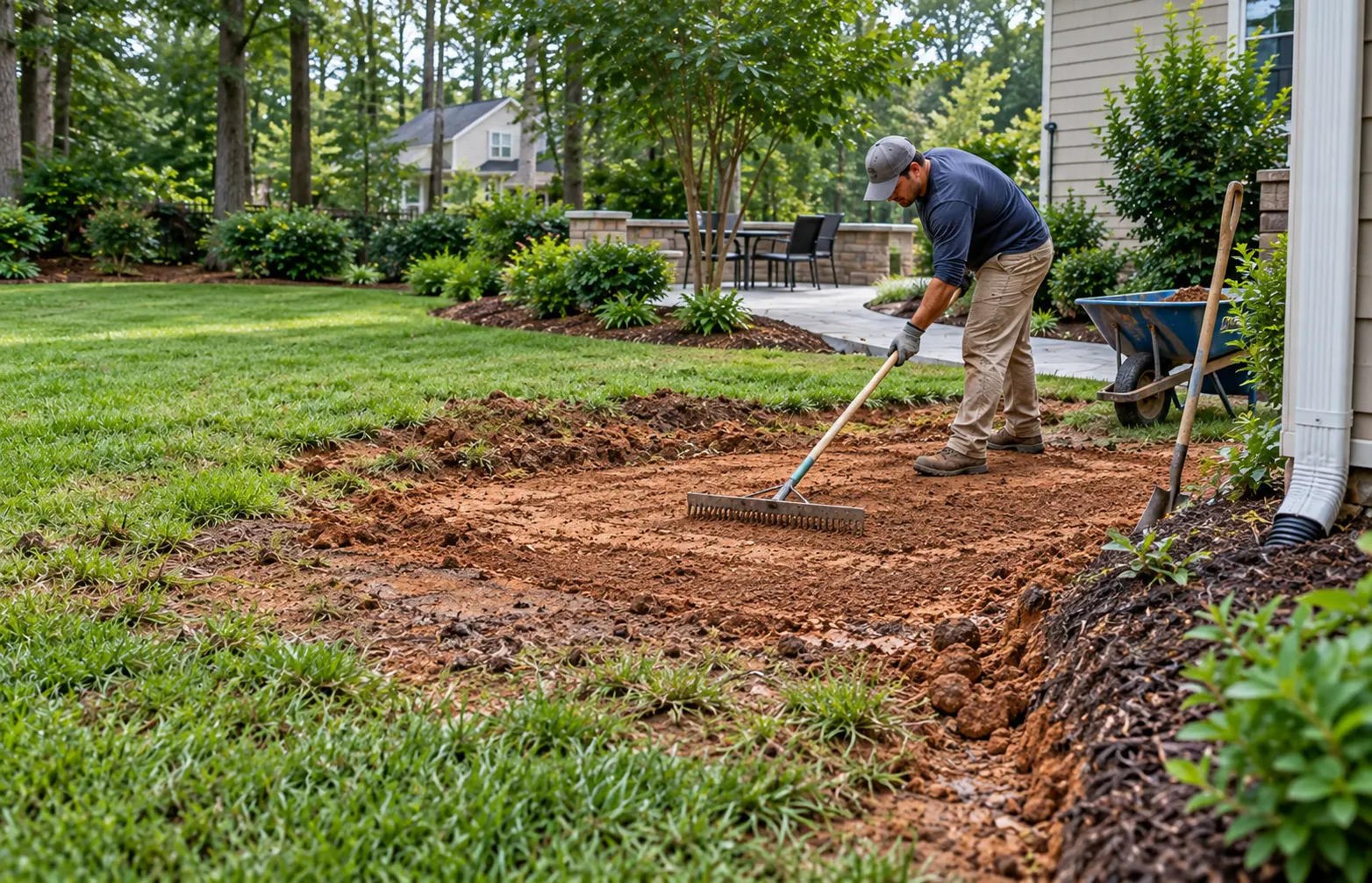
Yard Grading in Charlotte
Grading changes the shape or elevation of the ground so water can move more effectively. Depending on the project, it may involve filling low areas, reshaping a surface, establishing a more useful slope, preparing for drainage installation or restoring grade after other work.
Grading should not simply move a water problem from one part of the property to another. The intended water path and outlet should be considered before significant changes are made.
Can Regrading Fix Standing Water?
Sometimes. If pooling is mainly caused by a low area or inadequate surface slope, regrading may help. Water caused by concentrated roof runoff, saturated soil, hardscape elevations or another drainage issue may require a different or combined approach.
Lawn Leveling vs Yard Grading
These services can overlap, but they are not the same.
Lawn Leveling
Minor lawn leveling in Charlotte, NC may help correct shallow depressions, rough turf surfaces or small uneven areas. It is generally a smaller surface correction.
Yard Grading
Grading changes broader elevations or slopes and may be appropriate when water movement across a larger area needs to change.
Drainage Installation
Drainage installation adds a feature or system such as a French drain, catch basin, solid drainage pipe, downspout route or selected surface drain.
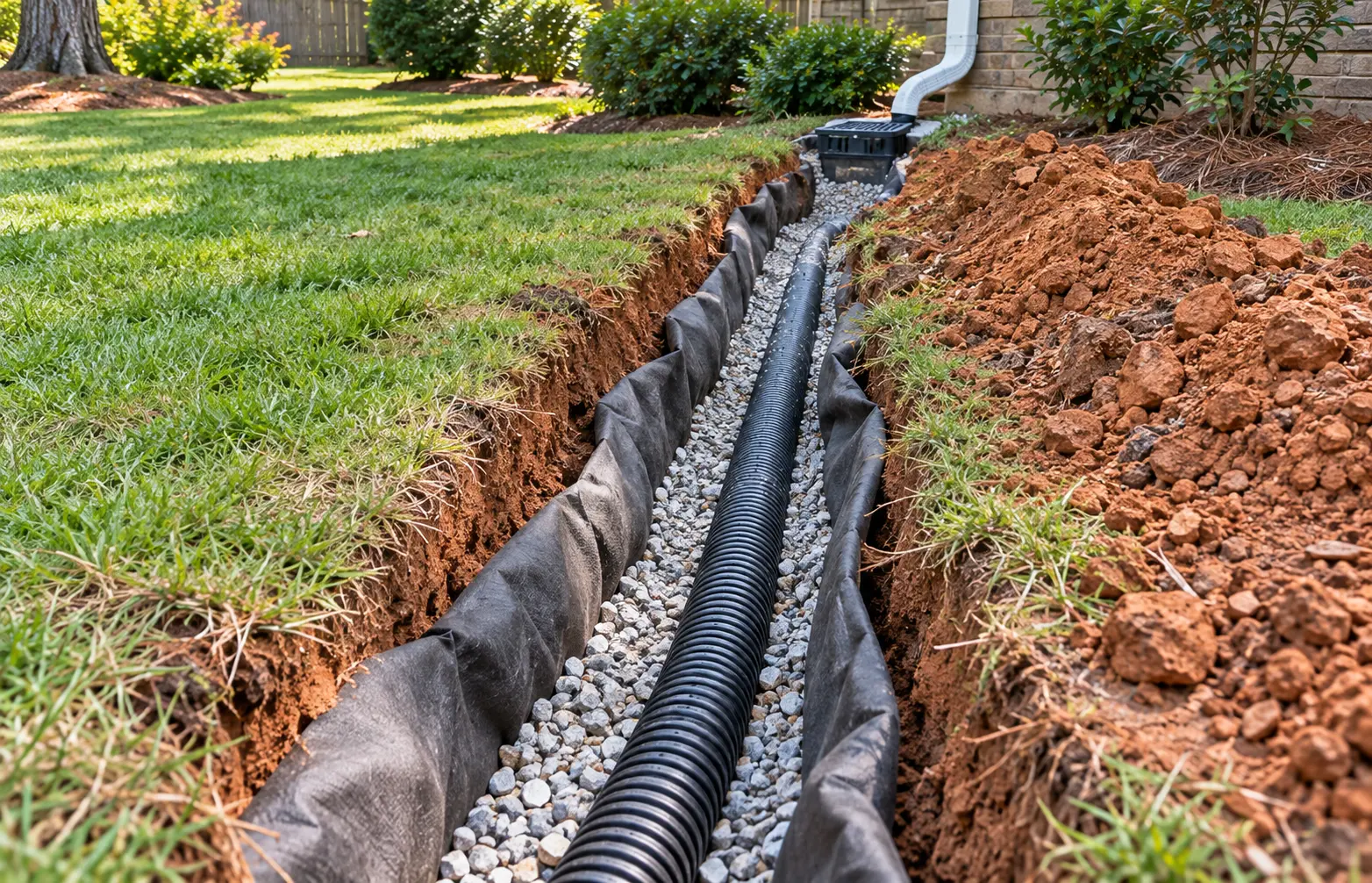
French Drains
A French drain is one possible method for collecting and redirecting subsurface or shallow groundwater. A system may include an excavated trench, drainage pipe, drainage aggregate, filter material where appropriate and a suitable outlet.
When Might a French Drain Be Considered?
It may be worth assessing when water moves through saturated soil or along a predictable subsurface path. It should not automatically be installed simply because a lawn has one visible low spot.
If the problem is mainly caused by surface grade, a surface correction may make more sense.
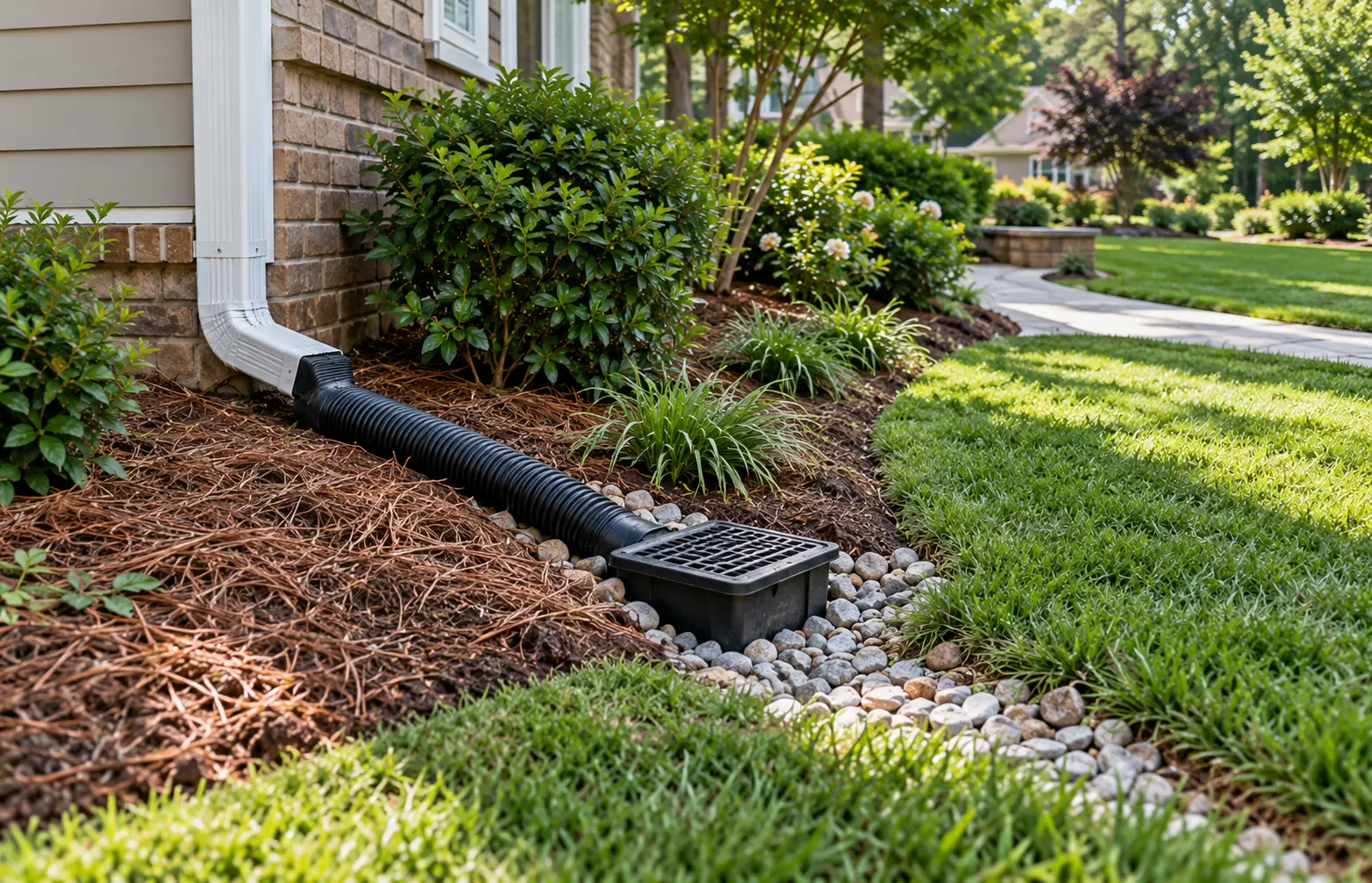
Catch Basins, Surface Drains & Downspout Routing
Catch basins and surface inlets collect runoff from a defined location and route it into drainage piping. They may be considered around low lawn areas, hardscape transitions, patio edges or places where water naturally gathers.
Roof runoff can also deliver a large amount of water to a small area. When a downspout empties into a low or poorly draining location, the starting point may involve extending the discharge, routing water through solid pipe, connecting to an appropriate drainage solution or modifying nearby grade.
Placement matters: adding a drain where water does not naturally reach it may do little to solve the problem.
Swales, Erosion & Runoff Control
A swale is a shallow shaped area that helps guide surface runoff along a planned path. Water moving too quickly can also create erosion rather than standing water.
Swales
A swale can sometimes manage surface water without relying entirely on buried drainage. Its usefulness depends on available slope, property layout, soil, surrounding landscaping, where water enters and where it can discharge.
Erosion
Signs can include soil washing away, channels forming after rain, mulch leaving beds, exposed roots, bare slopes or sediment collecting downhill. Simply replacing washed-out soil without changing the runoff pattern may allow the same erosion to happen again.
Charlotte Soil, Clay & Compaction
Charlotte lies within North Carolina’s Piedmont region. Soil condition can influence how quickly water enters and moves through the ground.
NC State Extension explains that much of the Piedmont subsoil has high clay content and that construction compaction can further reduce water movement. This does not mean every Charlotte property has identical soil or needs a drainage system. It means soil condition is one factor worth evaluating when a yard drains slowly or remains wet. NC State Extension →
Drainage Around Hardscaping, Turf & Planting
Water movement should be considered before installing improvements that may later cover or disturb the work area.
Patios & Walkways
Hard surfaces change runoff paths. A known drainage issue is easier to address before a new patio or walkway is finished.
Explore Hardscaping →Sod & Lawn Restoration
If standing water contributes to lawn failure, address the underlying water problem before repeatedly replacing turf.
Explore Landscape Installation →Ongoing Lawn Care
Once an underlying drainage issue has been addressed, ongoing mowing and turf care remain a separate maintenance scope.
Explore Lawn Care →Useful sequence: Identify Water Problem → Correct Drainage or Grade Where Needed → Restore Soil or Turf → Begin Appropriate Lawn Care.
Where Will the Water Go?
Collecting water is only part of a drainage solution. There also needs to be an appropriate discharge path.
Plan the Outlet
The appropriate outlet may depend on property slope, existing drainage patterns, drainage easements, property boundaries, public infrastructure, neighboring properties, streams or buffers and project-specific restrictions.
Do Not Treat the Property Line as an Automatic Outlet
Ask where water goes after it exits the system, whether the outlet can function by gravity, whether it could create erosion, whether another property could be affected and whether an easement or existing drainage feature is involved.
City of Charlotte stormwater review considers certain work that installs, modifies or affects drainage features such as catch basins, pipes, ditches and swales, and it also considers adjacent-property flooding. View Charlotte residential review guidance →
Drainage Easements, City Review & Underground Utilities
Not every residential drainage correction follows the same approval process. Requirements depend on the property and actual work.
Before excavation begins, clarify who is responsible for the 811 notice and for checking any project-specific City review, permits, drainage easements or other approvals.
Common Yard Drainage Mistakes to Avoid
Drainage work can fail when only the visible wet spot is considered.
No Workable Outlet
A drainage line needs somewhere appropriate to discharge.
Filling Without Diagnosing
Adding soil to a low spot may only shift the pooling if runoff continues entering the area.
French Drain by Default
Surface-water and subsurface-water problems may require different approaches.
Moving Water Elsewhere
A correction should not create a new erosion or flooding problem on another part of the property or an adjacent property.
Replacing Sod Too Soon
New turf can fail again if the underlying water problem remains.
Ignoring Utilities or Easements
Drainage projects may involve excavation or areas with existing drainage restrictions.
When a Larger Drainage Problem May Need a Specialist
Not every water problem belongs within ordinary landscape drainage work.
The appropriate level of professional involvement depends on the project.
Yard Drainage vs Foundation Waterproofing
Yard drainage addresses water moving across or collecting within the landscape. Water entering a basement, crawlspace, foundation or interior area may require waterproofing, plumbing or another building-related specialist. Do not assume a landscape drain alone will correct water entering a structure.
How Much Does Yard Drainage Cost in Charlotte?
Drainage costs can vary significantly because one project may involve a localized correction while another requires grading and a larger drainage system.
Rather than comparing only final totals, compare what each proposal actually includes.
What Should a Drainage & Grading Estimate Include?
A useful proposal should make the intended correction understandable.
Problem + Proposed Solution
Does the proposal explain where the water is coming from and whether the approach involves grading, French drainage, catch basins, downspout routing or another method?
Drainage Route + Outlet
Where will pipes, swales or other features run, and where is collected water intended to discharge?
Materials + Grading
Are relevant pipe, aggregate, inlet materials and any proposed elevation changes described clearly enough to compare?
Excavation + Restoration
What happens to removed soil and debris, and does the scope include restoration of disturbed lawn, beds or hardscape?
Utilities + Approvals
Who handles the utility-locate process and checks applicable drainage easements, City review or permits?
Exclusions + Terms
What is specifically not included, and what provider qualifications, insurance, pricing and service terms should be confirmed before hiring?
What Drainage Work May Not Include
Depending on the project, separate help may be required.
Do not assume these items are included unless they appear in the written scope.
What Should You Send With a Drainage Request?
Photos and information collected during or soon after rain can make the first discussion much more useful.
When possible, take photos during rain, immediately afterward, several hours later and after the area has mostly dried. This can show both the water path and how long the area remains wet.
How Does a Yard Drainage Request Work?
Describe the Problem
Explain where water collects, how often it occurs and which parts of the property are affected.
Send Photos
Include the problem area plus wider views showing slopes and surrounding features.
Identify Possible Water Sources
Show downspouts, hard surfaces, low points and runoff routes.
Review Site Conditions
A possible approach should consider the cause, grade, soil, access and outlet location.
Compare the Proposed Solution
Understand what will be installed or changed and why.
Verify Provider Details
Before hiring, confirm applicable qualifications, insurance, licensing where required, pricing, approvals and service terms directly with the provider.
Have Photos of the Water Problem?
Send the ZIP code, problem area and any photos or video showing how the water moves.
Drainage & Grading Requests Around Charlotte
Drainage conditions vary property by property. A neighborhood name does not mean every property has the same soil, grade or water problem.
Charlotte Neighborhoods
Drainage requests may come from areas such as Dilworth, Myers Park, Plaza Midwood, SouthPark and Steele Creek.
Nearby Communities
Depending on project type and independent provider availability, requests may also be considered from Matthews, Pineville, Huntersville and Concord.
Note: These location names describe the geographic focus of this website. They do not represent offices, employees, crews or completed projects in those areas.
Charlotte Area
NeighborhoodsFrequently Asked Questions About Yard Drainage & Grading in Charlotte
What causes standing water in a Charlotte yard?
Possible causes include low areas, inadequate surface grade, compacted or clay-rich soil, downspout runoff, hard surfaces, slope runoff or problems with an existing drainage feature. More than one factor may contribute to the same wet area.
Does standing water always require a French drain?
No. A French drain is one possible drainage method. Some properties may need grading, a catch basin, downspout routing, a swale or another approach instead.
What is the difference between surface and subsurface drainage?
Surface drainage manages visible runoff or pooling on top of the ground. Subsurface drainage addresses water moving through or remaining within saturated soil.
What is the difference between yard grading and drainage?
Grading changes ground elevation or slope. Drainage adds or modifies features that collect, convey or redirect water. Some projects use both.
What is a French drain used for?
A French drain may be used to collect and redirect water moving through saturated soil or along a predictable subsurface path. Whether it fits depends on the property.
When is a catch basin useful?
A catch basin may be useful where surface water consistently reaches a defined low point and can be routed to an appropriate outlet.
Can downspouts cause yard drainage problems?
Yes. Concentrated roof runoff can contribute to saturated soil or standing water when it discharges into a low or poorly draining area.
Can grading fix standing water?
It can when the primary problem involves surface elevation or slope. Other causes may require additional drainage work.
What is the difference between lawn leveling and grading?
Lawn leveling usually corrects smaller surface irregularities. Grading changes broader elevations or slopes and can influence how runoff moves across the property.
Can drainage problems cause lawn failure?
Persistent wet soil can stress turf and contribute to thinning or repeated lawn failure. The underlying water problem should be considered before repeated lawn restoration.
Should drainage be fixed before installing sod?
If drainage is contributing to existing lawn failure, addressing the underlying site problem before installing replacement turf can reduce the chance of repeating the same issue.
How much does yard drainage cost in Charlotte?
Cost depends on the drainage method, problem area, excavation, grading, materials, drainage-run length, outlet conditions, site access and restoration requirements.
What should a drainage estimate include?
It should explain the problem, proposed solution, work area, drainage route, outlet location, materials, grading, excavation, restoration, cleanup, responsibilities and exclusions.
Do I need approval for drainage or grading work?
Requirements depend on the property and project. Charlotte reviews certain residential work that installs, modifies or affects drainage systems or features, involves public storm easements, or creates other stormwater-review issues.
What should I send with a drainage request?
Send the ZIP code, wider and close-up photos, information about standing water or erosion, downspout locations, existing drainage features, slopes, hard surfaces and any video showing water movement during rain.
Understand the Water Before Choosing the Drain
A recurring wet area is a symptom. Ask where the water comes from, whether it is surface runoff or subsurface water, why it stops in that location, whether grade can improve the problem, where collected water can appropriately discharge and whether the work affects other landscaping or drainage infrastructure.
Landscapers in Charlotte NC is an independent landscaping information and service-request website. Drainage and grading work is performed by independent providers where available. Provider availability, qualifications, insurance, licensing where required, approvals, pricing, materials, warranties and service terms should be confirmed directly before hiring.