Choosing between sod vs. seeding is one of the first big decisions you’ll make when establishing a lawn in Charlotte, NC, and it’s not always obvious which way to go. Charlotte’s climate is a mixed bag. You’ve got hot, humid summers, unpredictable spring rain, and clay-heavy soil that doesn’t always cooperate. That combination makes lawn establishment trickier than it looks.
A lot of homeowners get stuck here. Do you spend more upfront for instant sod? Or do you save money and go the seeding route, knowing it’ll take longer? Both options work. But the right one depends on your budget, your timeline, and what your yard is actually dealing with.
In this guide, we’ll break down sod vs. seed across cost, growth speed, maintenance, durability, and long-term results, all with Charlotte’s specific conditions in mind.
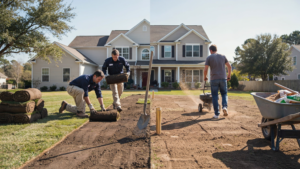
Sod is basically a lawn that’s already grown for you. It’s turfgrass that’s been cultivated on a sod farm, then harvested in rolls or slabs, roots, soil, and all, and installed directly on your property. The moment it goes down, you’ve got a lawn.
For Charlotte homeowners, sod installation means choosing a grass variety that fits the local climate. The most popular options are:
Before installation, the ground needs proper topsoil preparation and grading. Once the sod is laid, irrigation is critical. The roots need consistent moisture to bond with the soil beneath. Most sod installations in Charlotte need daily watering for the first two to three weeks during rooting.
Sod installation vs. seeding comes down to one main thing: speed. Sod gives you an instant lawn. If you want coverage today, sod is the fastest way to grow a lawn that’s ready to use.
Lawn seeding is the more traditional approach. You prepare the seedbed, spread grass seed across the area, and then wait for germination and growth to take over. It’s slower, but it’s also significantly more affordable.
The process starts with soil prep, loosening the ground, removing debris, and sometimes adding compost or fertilizer to give seeds the best chance. Once seeds are spread, you need consistent watering to keep the seedbed moist. Germination usually kicks in within 7 to 21 days depending on the grass type and conditions.
Seeding also covers a few specific scenarios. Overseeding is when you spread seed over an existing lawn to fill in thin or bare areas. Lawn renovation uses seeding to gradually restore a damaged or patchy yard without starting completely from scratch.
So how long does grass seed take to grow into a full lawn? Realistically, you’re looking at 8 to 16 weeks before it can handle regular foot traffic. That timeline depends heavily on soil temps, moisture, sunlight, and fertilization. Cool-season grasses like fescue germinate faster in fall here in Charlotte. Warm-season grasses like bermuda do better when you seed in late spring.
Grass seed vs. sod isn’t just a price comparison, it’s a patience comparison too.
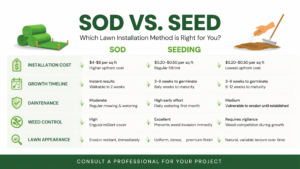
Here’s a quick side-by-side breakdown to help you see where each option stands:
Factor | Sod | Seeding |
Cost | Higher upfront ($1–$2/sq ft + labor) | Lower upfront ($0.10–$0.30/sq ft) |
Time to Establish | 2–6 weeks to root | 8–16 weeks to mature |
Weed Control | Immediate, dense coverage blocks weeds | Vulnerable to weeds during germination |
Maintenance | Heavy watering early, then moderate | Consistent watering through establishment |
Appearance | Instant, uniform, lush look | Patchy early on, fills in over time |
Durability | Ready for light traffic in 3–4 weeks | Fragile until fully established |
Lifespan | Long-lasting with proper care | Long-lasting with proper care |
Both can produce a beautiful, healthy lawn. The difference is how fast you get there and what it costs to start.
Let’s be direct, sod costs more. A lot more upfront.
For sod installation in Charlotte, you’re typically looking at $1.00 to $2.00 per square foot just for the sod itself. Add labor, soil prep, and irrigation, and the total cost for a standard yard can run anywhere from $3,000 to $8,000 or more depending on size.
Lawn seeding is a fraction of that. Grass seed runs $0.10 to $0.30 per square foot. Even with fertilizer, topsoil amendments, and labor, you’re looking at a fraction of what sod costs for the same square footage.
So is sod cheaper than seed? No, not upfront. But cost of sod compared to seed isn’t the whole story.
With seeding, you might spend less initially, but you’ll spend more time and money on weed control, reseeding thin spots, and irrigation through a long establishment period. If a dry spell hits during germination, you could lose a significant portion of your seed and have to start over.
Sod has higher sod pricing vs. seeding pricing upfront, but it gives you a much more predictable outcome. Less risk of failure, less exposure to weeds, and faster results.
When does seeding make more sense financially?
For most Charlotte homeowners with a standard residential yard, affordable lawn installation doesn’t always mean the cheapest way to start a lawn. It means the option that gives you the best return for what you spend.
This one isn’t close. Sod wins on speed every time.
Sod vs. seed growth time looks like this: sod roots into the soil within 2 to 6 weeks. After that, it’s essentially a functional lawn. You can mow it, walk on it, and let the kids out. How long does sod take to root fully? In Charlotte’s climate with proper irrigation, expect solid rooting by week four or five in warm months.
Grass seed is a different story. Germination starts within a week or two, but how long does grass seed take to grow into a usable lawn? You’re realistically waiting 8 to 16 weeks, and that’s under good conditions. Hot, dry summers in Charlotte can slow germination significantly. A drought during establishment can kill seedlings before they have a real chance.
Weather matters a lot with both options. Sod is more forgiving because the root system is already developed. Seed is fragile during the germination window and needs consistent moisture and sunlight to take hold.
If you need quick lawn replacement options, say, for a home sale, a special event, or erosion control after construction, sod is the clear answer. An instant lawn vs. seeded lawn comparison always favors sod when timing is the priority.
Maintenance looks different depending on which route you choose, especially in those first few months.
Right after sod installation:
Watering is the most critical task. You’ll need to water daily, sometimes twice a day in Charlotte’s summer heat, for the first two to three weeks. Once rooting takes hold, you scale back to a normal schedule. Mowing can start once the grass reaches about 3.5 inches, usually around week three or four. Weed control is largely handled by the dense turf itself, but you’ll want to watch for any early invaders around edges.
Right after lawn seeding:
Watering is just as intense, but more frequent and lighter. You want to keep the seedbed consistently moist without washing seeds away. Mowing starts later, not until grass reaches about 3 inches, which could take six to eight weeks. Weed control is a challenge here. Open soil during germination is an open invitation for weeds, and you can’t use most herbicides on new seedlings without damaging them.
Long-term, sod care vs. seed care evens out considerably. Both need regular mowing, fertilization, aeration, and seasonal lawn care. Neither requires dramatically more maintenance after that first establishment phase.
Whether you choose sod or seeding, consistent lawn upkeep is essential for healthy growth. Professional Lawn Care and Maintenance Service can help ensure proper mowing, fertilization, irrigation, and weed control throughout the year.
Here’s the thing, when both options are properly established, they can last just as long. A well-maintained seeded lawn is just as durable as a sod lawn. The difference is in the journey to get there.
Sod durability advantages:
Sod produces a thicker lawn faster. The dense root system means better resilience against foot traffic, drought, and disease right from the start. Within a couple of months, you’ve got a mature turfgrass surface with real density and curb appeal. Bermuda and zoysia sod are particularly tough in Charlotte’s heat and perform well with proper irrigation.
Seeding durability advantages:
Seeded lawns sometimes develop deeper roots over time because the grass grows from scratch in your specific soil. Some lawn experts argue that a seeded lawn becomes more adapted to local conditions. That said, this advantage is marginal if your soil is properly prepared for sod.
Which lawn option lasts longer really depends on maintenance, not the installation method. A neglected sod lawn will fail. A well-tended seeded lawn can look spectacular for decades.
For drought resilience, warm-season sod varieties like bermuda and zoysia have a strong edge over cool-season seeded grasses during Charlotte’s hot summers. If drought tolerance and appearance are priorities, sod gives you a head start.
Timing matters a lot in Charlotte. The local climate, hot summers, mild winters, and unpredictable springs, creates specific windows for each option.
Best time for sod installation:
Best time for lawn seeding:
For most Charlotte homeowners, fall is the sweet spot for seeding and spring is the sweet spot for warm-season sod. Lawn establishment by season makes a real difference in success rates here.
Charlotte sits on some notoriously heavy clay soil. It drains poorly, compacts easily, and makes it harder for roots to penetrate. That affects both sod and seeding differently.
Sod on clay soil:
Sod can be installed on clay, but proper topsoil preparation is essential. If sod goes down on hard, unprepared clay, the roots struggle to establish and the lawn may thin out or fail. A good contractor will amend the soil, improve drainage, and sometimes add a layer of topsoil before laying sod.
Seeding on clay soil:
Seeding on clay is also challenging. Seeds need loose, well-aerated soil for good germination. Heavy clay can crust over and block emerging seedlings. Soil preparation, tilling, compost amendment, and drainage improvement, is critical before seeding on clay.
For erosion control on slopes, sod has a significant advantage. It provides immediate ground coverage and holds soil in place from day one. Seed on a slope is vulnerable to washing away in Charlotte’s heavy rain events before it establishes.
The best lawn installation method in Charlotte always starts with understanding your soil. Whether you choose sod or seed, clay soil needs attention before anything goes down.
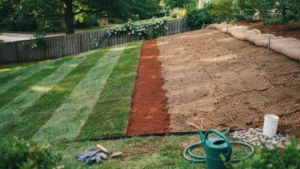
New construction is one of the most common situations for sod vs. seed decisions. Construction typically strips away topsoil, leaving compacted, nutrient-poor ground behind. In these cases, sod is often the better choice. It provides instant coverage, protects against erosion, and looks great when you’re moving in. For a new lawn on a new home, sod gives you predictable, fast results without the long establishment wait.
For smaller bare spots or damaged areas, seeding is usually more practical and affordable. Full sod replacement for a few patches is often overkill. Overseeding or spot seeding works well for smaller lawn renovation projects. If bare spots are extensive or in high-visibility areas, sod patches can be a faster fix.
For large yards, seeding is often the more practical choice, simply because the sod cost becomes enormous at scale. A half-acre lawn in sod could easily run $10,000 or more. The same area seeded costs a fraction of that. Large properties also have more room to absorb the slow establishment period, making the patience required for seeding more manageable. Large-scale lawn restoration or revegetation projects almost always favor seeding on cost grounds.
Here’s the simple breakdown.
Choose sod if:
Choose seeding if:
Is sod worth it? Yes, if speed, appearance, and certainty matter to you. Is seeding worth it? Absolutely, if you have patience and want to keep costs down. The best option for lawn installation comes down to your specific situation, not a one-size-fits-all answer.
Picking between sod or seeding is just the starting point of your outdoor space. Once the lawn is handled, most homeowners turn their attention to landscape beds, borders, and groundcover materials. These choices affect maintenance, moisture retention, and overall appearance just as much as your lawn does.
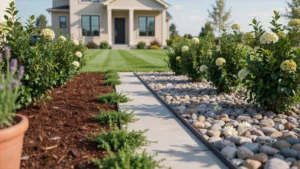
After selecting sod or seeding, homeowners should also evaluate groundcover materials for landscape beds. Our guide on mulch vs. rock landscaping explains how different materials impact maintenance, moisture retention, appearance, and long-term landscaping costs.
If you’re still weighing sod vs. seeding in Charlotte, NC, the best move is to get a professional eye on your specific property. Soil conditions, slope, sun exposure, drainage, and your timeline all factor into what makes sense for your yard.
Our team provides full-service Landscaping Services in Charlotte NC, including:
We work with Charlotte homeowners on everything from small backyard projects to large residential properties, and we know exactly how Charlotte’s climate, soil, and seasonal patterns affect your choices.
Whether you’re a Charlotte sod installation company client looking for a fast turnaround, or you’re exploring lawn seeding options to save money on a larger project, we’ll help you figure out what actually makes sense for your situation.
The sod vs. seeding debate doesn’t have a universal winner, but for your property, there’s almost always a clear best option. It comes down to four things: budget, timeline, maintenance expectations, and your yard’s specific conditions.
Sod gives you speed, instant curb appeal, and lower risk. Seeding gives you affordability and works beautifully when conditions and timing are right. Both can produce a healthy, long-lasting lawn in Charlotte, with the right preparation and ongoing care.
Don’t guess. Contact our team today for a professional lawn assessment. We’ll walk your property, evaluate your soil, and give you a straight recommendation on whether sod or seeding is the right call, along with a detailed quote for lawn installation in Charlotte, NC.
Your lawn starts here. Let’s get it right.